
剑雨
Tight hug after 27 years: Reunion across ocean, marking China-US folk friendship_我的网站

A |
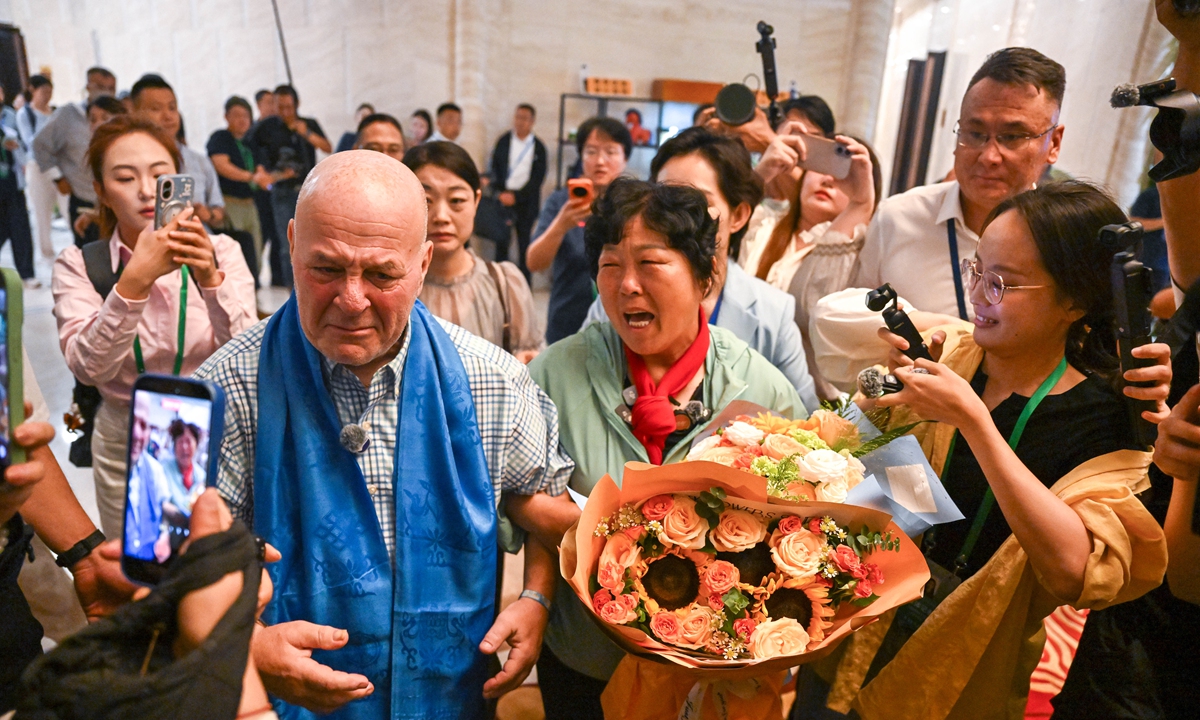
A long-awaited reunion that captured wide public attention unfolded on Sunday evening when American teacher Ronald Sakolsky and Yin Yuzhen, a model worker renowned for planting trees and combating desertification, reunited and embraced tearfully with overwhelming emotion at an airport in Ordos, North China's Inner Mongolia Autonomous Region, after 27 years of separation across the ocean.
The reunion began with a single act of generosity in 1999. When Sakolsky arrived in China as a participant in a China-US education exchange program, he was moved by Yin and her husband's tireless efforts to curb desertification in the Mu Us Desert in Inner Mongolia. He raised $5,000 to fund their local tree-planting initiative. The young saplings they bought with the donation have since matured into more than 50,000 full-grown trees, transforming the once desolate, sandy wasteland into a thriving green landscape.
This hug, transcending time and distance, marked not only friendship between the two countries, but also showcased the sincerity of Chinese people and a green miracle made possible through continuous joint efforts.
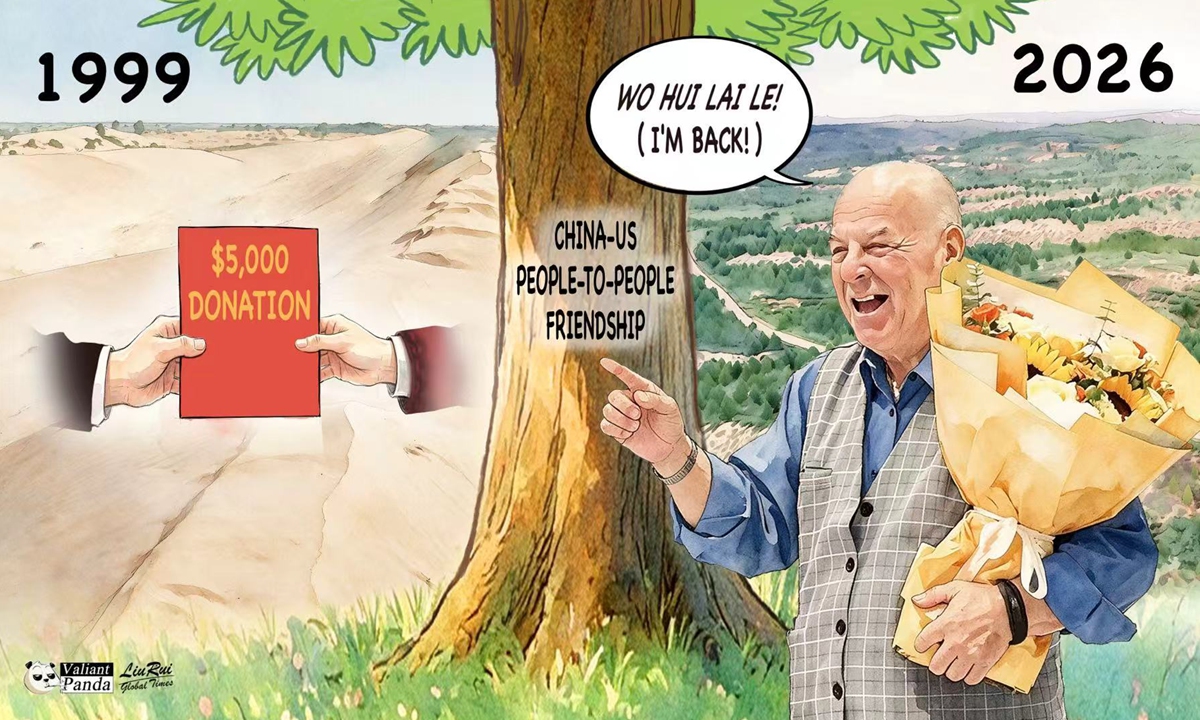
At 2:48 am on early Sunday morning, Ronald Sakolsky arrived at Beijing Capital International Airport after over 10 hours of flight. As he stepped into the arrivals hall, he greeted the waiting reporters with earnest Putonghua "Wo hui lai le," meaning "I'm back."
"When I saw the lights in Beijing as we were landing is when I realized that I am back in my second home."
Asked what he is most looking forward to about this journey, Sakolsky told the Global Times that "I want to see Ms Yin, see the forests, see the students I have not seen for almost 30 years, my colleagues. I want to see the Chinese people."
He then flew to Ordos for the meeting with his desert reclamation partner.
Yin waited at the arrival gate at the airport in Ordos very early, murmuring English sentence she particularly learned for this occasion - "Welcome to China, my brother." Her eyes were fixed on the escalator and she wiped away her tears multiple times during the wait, the Global Times reporter observed.
Sakolsky said in earlier interview with the Global Times that he was looking forward to this reunion and could not hold his tears back when he thought of the moment. He was about to give Yin a hug when they meet.
When Sakolsky finally appeared in front of Yin, their eyes welled up. Stepping off the elevator, Sakolsky could barely contain his excitement, muttering "Oh my God, oh my God." They hurried toward each other and locked in a tight embrace at last - the long-awaited hug 27 years in the making.
"This is a dream come true, from a lady who is the hero of the story, not me," Sakolsky told the Global Times at the airport, barely holding his emotion. "She made a promise 27 years ago, and she kept her promise."
Talking about his donation almost three decades ago, Sakolsky said the purpose was to help her, "because she was beautifying the motherland."
Now, in response to an invitation to return to China for a trip to see the green planting from his donation and to returning to the city of Luoyang, Central China's Henan Province, where he taught in the exchange program for several years, Sakolsky noted that "China had done so much for me that I wanted to say thank you to China."
A return of kindness
For this reunion after 27 years, Yin had carefully prepared. Steamed buns, meaning "upward," fresh vegetables and fruits picked in the land transformed from desert.
Yin, never familiar with any foreign language, learned some English phrases, including "welcome to China" she practiced, "my brother" to greet Sakolsky, and "more, more" to persuade the American friend to eat more.
On Sunday, Yin did her hair and wore a red scarf alongside an outfit with a green shade, which she picked particularly for the reunion, as "green is the color of the Earth," as she told the Global Times.
Yin is not the only old friend that was looking forward to the reunion.
While Sakolsky was still on his over-10-hour flight from the US to Beijing, Bai Fan was also on the way - driving over 850 kilometers from Luoyang to Inner Mongolia. The journey would take a day and a half.
Bai was the vice principal of Luoyang Foreign Language School, overseeing international affairs. Sakolsky was an exchange teacher there through a China-US program, and was Bai's "neighbor right across the hall."
Why drive such a distance? Bai had prepared special cultural gifts - peony porcelain and Hanguan Kiln purple clay tea ware, distinctive local handicrafts that proved too bulky and fragile for air travel or high-speed rail.
Bai recalled Sakolsky's continuous interest in Chinese culture, and sending a replica of Terracotta Warriors to the US at Sakolsky's request. "I hope he can take these Luoyang elements and Chinese symbols to the world," Bai told the Global Times in a phone interview on Sunday.
Bai is also eager to see Sakolsky at a place that they had traveled together 27 years ago. When Sakolsky came to Luoyang for the exchange program, Bai was his designated liaison. Together, they traveled to the heart of the Mu Us Desert to deliver the $5,000 donation.
Bai still vividly remembers the desolate desert back then, where finger-thin saplings were watered ladle by ladle by Yin. At that time, Sakolsky had constant concerns about whether the tiny saplings could survive in the wasteland, which makes today's sprawling 50,000-tree forest even more miraculous.
The changed and unchanged
Things have changed over the past 27 years. While waiting for Sakolsky, Yin jokingly said he got less hair, and she would not be able to recognize him if running up to him on street.
The passage of time has brought far more than personal aging, according to Bai, another witness to the decades-long changes. "Everyone is growing older. Our families have expanded with more children, local communities have grown in population, and the surrounding environment is constantly evolving, just as our cities are undergoing profound transformations."
On a night tour in Ordos on Sunday, Sakolsky, watching a fountain light show, said that "it is a 21st century city, but it looks like a 22nd century city. In the 2000s, Chinese government made a promise to Chinese people to beatify this country, and they succeeded."
For Sakolsky, probably the most profound transformation lies in the depth of his human connection forged.
"27 years ago, we were just friends and acquaintances. We are brother and sister now. So much has happened since then, but the important thing is many people have seen the story and now they can also help to make China beautiful," he told the reporters.
Through joint efforts of people like Yin, the Mu Us Desert has turned from wasteland into a green oasis. China has contributed about 25 percent of the world's newly added green areas and taken the lead in achieving zero growth in land degradation, per official data.
Meanwhile, there are things unchanged, including a vintage photo of the three standing in the desert that has decorated Bai's office through all these years - a permanent reminder of their original aspiration.
This reunion will witness them retake the classic photo and plant new saplings together, expanding their green mission.
。

B | 第二款要求“产生、收集厨余垃圾的单位和其他生产经营者,应当将厨余垃圾交由具备相应资质条件的单位进行无害化处理”,其中所说的“单位和其他生产经营者”包括学校、机关、企业等的食堂,从事餐饮服务的宾馆、饭店、个体工商户等,而不包括家庭个人餐厨垃圾的产生和收集,即不包括家庭“剩菜剩饭”。即使是个人,也必须是从事生产经营者。第三款是禁止性条款,即“禁止畜禽养殖场利用未经无害化处理的厨余垃圾饲喂畜禽”,也就是说,畜禽养殖场是不能随便将厨余垃圾饲喂畜禽的。只有经过无害化处理的厨余垃圾,才能饲喂畜禽。“法典没有禁止家庭个人将剩菜剩饭直接饲喂家庭自己养殖的少量畜禽,比如,农村家庭将家里的剩菜剩饭饲喂自己家养的猪狗鸡鸭,是不在禁止之列的。而且根据法典规定,利用未经无害化处理的厨余垃圾饲喂畜禽也不在禁止之列。”王灿发说。在处罚方面,生态环境法典第1174条规定对“产生、收集厨余垃圾的单位和其他生产经营者未将厨余垃圾交由具备相应资质条件的单位进行无害化处理”的,处十万元以上一百万元以下的罚款;对个人的这类违法行为处一百元以上五百元以下的罚款。同时,法典第1231条规定,对“畜禽养殖场利用未经无害化处理的厨余垃圾饲喂畜禽”的,由生态环境主管部门、环境卫生主管部门按照职责分工责令改正,可以处十万元以下的罚款;情节严重的,报经有批准权的人民政府批准,责令停业、关闭。违法行为是否一律处罚?“根据生态环境法典第1231条规定,如果投喂的泔水未经无害化处理,则可能受到相应处罚。”中国社会科学院法学研究所生态法研究室助理研究员林潇潇说,但需要注意的是,第一,在一般情形下,本条的“强制性”责任是责令整改,罚款是执法机关“可以”采取的处罚形式,这意味着执法机关应在必要而非所有情况下进行罚款处罚;第二,根据法典第1056条规定,“违法行为轻微并及时改正,没有造成危害后果的,不予处罚”,因此,罚款并非必然结果。林潇潇告诉记者,禁止泔水等未经处理的厨余养殖,立法初衷是保障公共卫生安全和食品安全。国务院办公厅于2018年印发关于进一步做好非洲猪瘟防控工作的通知,明确要求“严防餐厨废弃物直接流入养殖环节”。

C | 2020年固体废物污染环境防治法的修改反映了该项要求,而相关条款也最终被纳入生态环境法典,并实现了相应的优化调整。对于广大养殖户或相关经营主体而言,应正确认识生态环境法典相关条款的意义和必要性,自觉遵守法律。
Current article:http://vhxz51.recuigoutoubaozukai.pics/news/20260826_8729.html
Published on:19:10:17


